From Concept to Launch-Ready Food Retail Venture
“We’ve seen steady growth since we started. The process is smooth, and the impact is noticeable across all platforms.”

How Bearberry Donut Co. was developed into a differentiated food retail concept with a premium brand, operating model, product strategy, and launch-ready customer experience
Venture
Bearberry Donut Co.
Sector
Food and Beverage
Specialty Retail
Hospitality
Consumer Brand
Local Commerce
Capabilities
Venture Strategy
Brand Strategy
Retail Concept Development
Customer Experience Design
Menu Strategy
Packaging Design
Operating Model Design
Supplier Strategy
Real Estate Planning
Launch Planning
Executive Summary
Bearberry Donut Co. was developed as a premium donut concept for Bentonville, Arkansas, built around a simple but differentiated idea: create a better donut experience through natural ingredients, elevated flavors, thoughtful branding, and a retail environment that feels more like a modern hospitality brand than a traditional donut shop.
The opportunity was not just to open another bakery. The goal was to create a differentiated consumer brand in a market with strong foot traffic, growing population density, and a customer base increasingly shaped by Walmart professionals, young families, apartment residents, and visitors to Northwest Arkansas.
The venture required more than a logo or menu. It required a full business concept: brand positioning, product architecture, packaging, store experience, ingredient strategy, operating model, production planning, vendor research, buildout planning, staffing assumptions, and launch strategy.
The work resulted in a premium donut brand with a secured retail location, a defined product direction, a refined visual identity, a distinctive customer experience, and an operating model designed around the realities of a small-format retail space.
The Situation
Bentonville is a rapidly growing market with a unique mix of corporate professionals, families, tourists, cyclists, entrepreneurs, and local residents. The city has strong demand for quality food experiences, but many categories still have room for elevated local concepts that feel intentional, design-led, and premium.
Donuts presented a clear opportunity. The product is familiar, accessible, and high-frequency, but the category is often dominated by traditional shops, generic branding, artificial ingredients, and limited customer experience differentiation.
Bearberry Donut Co. was created to occupy a different position in the market: a premium, health-forward donut shop built around better ingredients, elevated flavors, refined packaging, and a stronger retail experience.
The concept was designed for a 738-square-foot retail space at The Lumen, a mixed-use apartment development in Bentonville. The location offered a strong strategic foundation: residential density above the store, proximity to Walmart-related traffic, and placement near major quick-service restaurant brands on a highly active commercial corridor.
The Strategic Opportunity
The opportunity was to build a donut brand that could win on more than convenience.
Bearberry needed to compete across four dimensions:
1. Product quality
The product needed to feel meaningfully better than a standard donut. That meant developing a flavor strategy around premium ingredients, natural colors, better sourcing, and more elevated combinations.
2. Brand differentiation
The market did not need another generic donut shop. Bearberry needed a distinctive name, visual identity, packaging system, tone, and store experience that could make the brand feel ownable from day one.
3. Operational feasibility
The retail space was small and ventless, which created real production constraints. The operating model had to solve for frying, storage, transport, display, staffing, and daily execution without overbuilding the space or taking on unnecessary cost.
4. Launch credibility
Because the business was being built from scratch, the concept needed to feel real before opening. The brand, packaging, store design, menu, and customer experience all had to communicate confidence, polish, and readiness.
The Challenge
The core challenge was building a premium food retail concept within the constraints of a small-format, ventless storefront.
A traditional donut shop operating model would have required more kitchen infrastructure, more equipment, more back-of-house space, and likely a larger buildout budget. Bearberry’s location had strong commercial potential, but the space needed a smarter operating model.
The business also had to balance several competing needs:
Create a premium brand without making the product feel inaccessible
Use better ingredients while maintaining operational consistency
Design a high-end store experience in a compact footprint
Develop a differentiated menu without overcomplicating production
Build a launch-ready business without overspending before proof of demand
Solve production constraints without compromising the customer experience
This made the work both strategic and practical. Every brand decision had to connect to an operating decision. Every product decision had to connect to sourcing, production, packaging, and daily execution.
The Mandate
The mandate was to take Bearberry from concept to launch-ready venture foundation.
This included building the core elements of the business:
Brand positioning
Visual identity direction
Menu architecture
Flavor strategy
Ingredient philosophy
Packaging system
Retail experience
Store layout and atmosphere
Production model
Supplier research
Buildout planning
Staffing assumptions
Launch strategy
Customer experience design
The goal was to create a business that could open with a strong point of view, a premium customer experience, and an operating model matched to the constraints of the space.
The Approach
The work was organized around five major workstreams.
1. Defining the brand position
The first step was defining what Bearberry should stand for.
The brand was positioned around a premium but approachable idea: better donuts made with better ingredients, presented through a more refined and memorable experience.
The brand direction moved away from the traditional donut shop playbook. Instead of loud colors, generic pastry imagery, and commodity positioning, Bearberry was built to feel warmer, more natural, more elevated, and more hospitality-driven.
The brand idea centered on:
Natural ingredients
Premium flavors
Thoughtful sourcing
A refined customer experience
Memorable packaging
A shop environment worth visiting
A product that feels indulgent but more intentional
This gave the business a clear position: not a health food brand pretending donuts are healthy, but a better-for-you indulgence brand built with more care.
2. Building the product and menu strategy
The menu was designed to give Bearberry a differentiated flavor system from the beginning.
Rather than relying only on standard donut flavors, the product architecture included familiar anchors alongside more premium and globally inspired flavors.
The menu direction included flavors such as:
The Cardinal Pom
Gold Coast Dark
Ecuador Reserve
Ivory Bean
Cinnamon Ember
Salted Amber
Plain Glaze
Lumencello
Kyoto Cream
Midnight Berry
Strawberry
Bramble Roast
This structure gave the brand a stronger culinary identity. The flavors created room for storytelling, premium pricing, and seasonal extension while still including accessible options for everyday customers.
The product strategy also emphasized natural ingredients and avoiding artificial dyes. This was important because it gave the brand a more modern food philosophy and created a clear point of difference in a category that often relies on artificial colors and overly sweet formulations.
3. Designing the customer experience
Bearberry’s customer experience was designed to feel premium from the first touchpoint.
That included the store environment, product presentation, packaging, signage, and the broader emotional tone of the brand.
The store concept was built around a compact but elevated experience:
A warm and refined interior
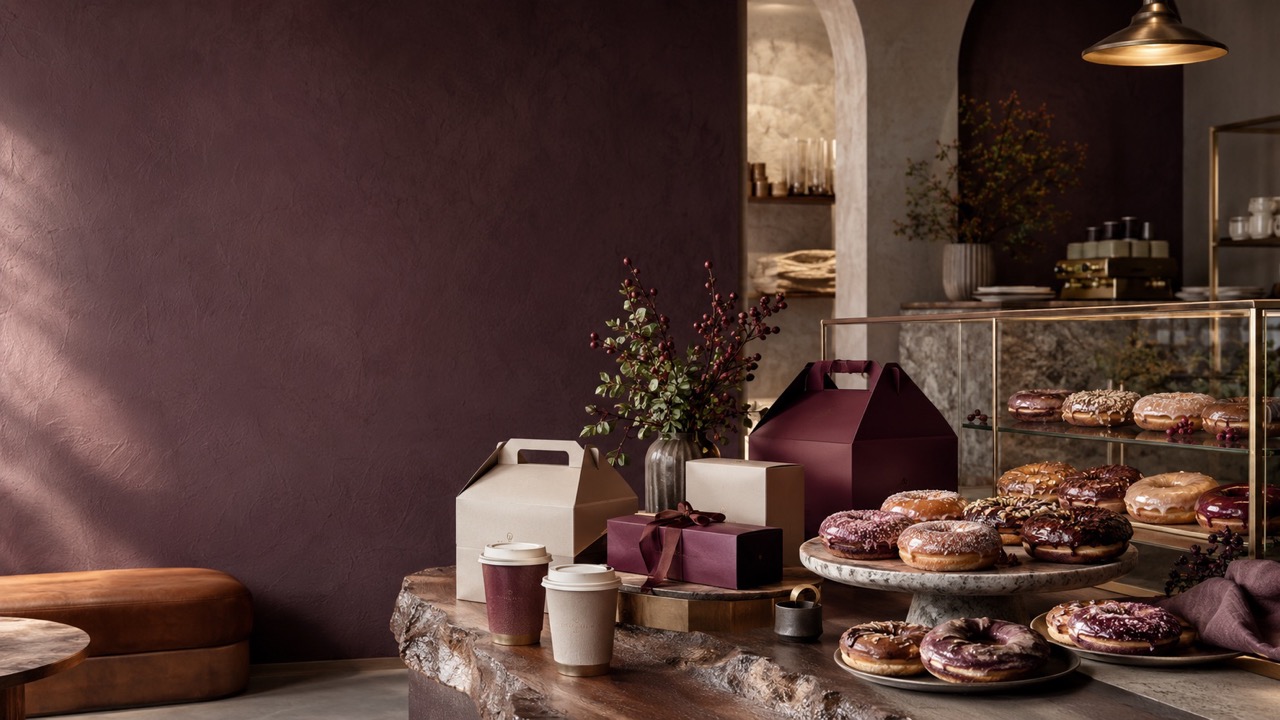
A dark plum matte Roman clay wall direction
Wood floors
Live-edge tables
Leather seating
Exposed ceiling direction
Minimal but intentional seating
A strong visual anchor through the bear mascot and brand assets
Premium packaging that makes the product feel giftable and memorable
The goal was to create a shop that felt distinctive enough to photograph, share, and remember, while still being operationally simple enough for a small retail footprint.
Bearberry was designed not only as a place to buy donuts, but as a small branded world: product, space, packaging, and atmosphere working together.
4. Solving the operating model
The biggest operational challenge was the ventless retail space.
A standard on-site frying model would have added complexity, cost, permitting challenges, equipment constraints, and space pressure. Several ventless options were explored, including commercial equipment paths, but the final operating direction was to fry off-site in a commercial kitchen and transport product to the store.
This decision helped simplify the retail footprint and allowed the storefront to focus on the customer experience, display, coffee, packaging, and sales.
The operating model accounted for:
Off-site production
Commercial kitchen usage
Morning transport
Retail display
Small-format staffing
Ingredient sourcing
Packaging flow
Buildout constraints
Equipment needs
Daily product volume targets
The goal was to create a model that could launch lean, validate demand, and avoid unnecessary buildout complexity before the business had operating data.
5. Creating the launch foundation
The launch plan included the key pieces required to make the business credible before opening.
This included securing the retail location, defining the store concept, developing the menu, exploring ingredient and supplier relationships, creating packaging direction, working through buildout needs, and preparing the brand for market introduction.
The business foundation included:
Lease secured at The Lumen in Bentonville
738-square-foot retail footprint
Off-site production model selected
Menu direction finalized
Premium packaging direction developed
Store experience direction created
Ingredient philosophy defined
Supplier research started
MEP and buildout needs identified
Opening strategy shaped around a compact retail model
What Was Built
Bearberry became more than a donut idea. It became a structured venture with a clear brand, operating logic, and launch path.
The work created:
A differentiated premium donut concept
A clear brand positioning strategy
A health-forward ingredient philosophy
A full flavor and menu architecture
A premium packaging system
A distinct store experience direction
A location strategy tied to Bentonville growth
A production model built around off-site frying
A small-format retail operating model
A supplier and ingredient sourcing strategy
A buildout plan for a compact storefront
A launch-ready foundation for market entry
The Outcome
Bearberry moved from concept into a launch-ready business foundation.
The venture secured a retail location at The Lumen in Bentonville and developed the strategic, creative, and operational components required to prepare for opening.
The work clarified what the business is, who it serves, how it should feel, how the product should be positioned, how production should work, and how the customer experience should come together.
Most importantly, the project created alignment between the brand promise and the operating model. Bearberry was not designed as a beautiful concept disconnected from execution. It was designed as a premium food retail brand that could operate within the constraints of a real space, a real buildout, and a real launch timeline.
Impact
Secured a strategic retail location in Bentonville
Defined the full premium donut brand concept
Created a differentiated menu and flavor architecture
Established a natural ingredient and better-for-you positioning
Developed a premium packaging and customer experience direction
Solved a major operational constraint through an off-site production model
Reduced buildout complexity by separating production from retail experience
Created a small-format operating model for launch
Built a cohesive foundation across brand, product, space, and operations
Positioned the business for a stronger market entry
Why This Matters
Many food businesses fail because the concept, brand, product, and operating model are developed separately.
Bearberry was built differently.
The brand was not treated as decoration. It was treated as a business system. The menu was not treated as a list of flavors. It was treated as product architecture. The storefront was not treated as a simple retail space. It was treated as a customer experience platform. The production model was not treated as a back-end detail. It was treated as a strategic decision that shaped cost, complexity, and launch feasibility.
That integrated approach is what gave Bearberry a stronger foundation.
The business was designed to enter the market with a clear identity, a premium customer experience, and an operating model grounded in the realities of the location.
Portfolio Summary
Bearberry Donut Co. was developed from concept into a launch-ready premium food retail venture in Bentonville, Arkansas. The work included venture strategy, brand positioning, menu development, packaging direction, retail experience design, ingredient strategy, supplier research, operating model design, real estate planning, and launch preparation. The result was a differentiated donut brand with a secured location, a clear product strategy, a premium customer experience, and an operating model built around off-site production and small-format retail execution.
Explore more blogs

Let’s create something exceptional together

From content to execution, we help brands transform attention into real, scalable results.